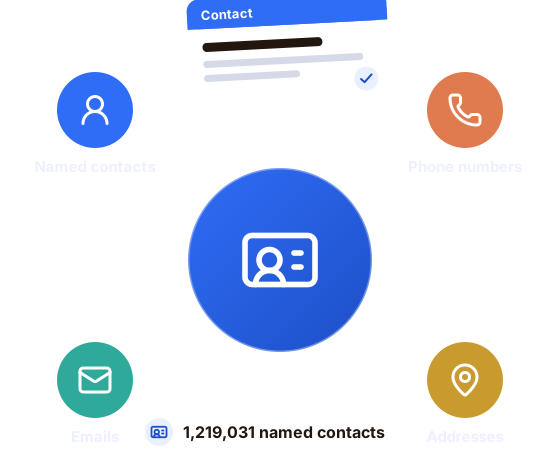
- B2B contact data is the name, job title, business phone number, business email and postal address of people who work at other businesses.
- We hold 1,486,280 UK business records in 2,284 categories, with 1,219,031 named contacts and 454,737 named contact emails (November 2026).
- Prices run from £295 to £170 per 1,000 records depending on order size, plus VAT; minimum order £300. 5,000 records cost £1,225.
- Every business we supply is a limited company, LLP or PLC (no sole traders or partnerships), so under PECR you can email them without opt-in consent.
- Check numbers against the TPS and CTPS before calling, and let named contacts know where their details came from within a month.
- Ask for a free count and sample records before you buy anything.
What is B2B contact data?
B2B contact data is information that lets you reach the people who run or buy for other businesses: their name, job title, business phone number, business email address and the company's postal address. It's used for sales prospecting, telemarketing, email campaigns and direct mail aimed at decision-makers rather than at a company in general.
Most business data tells you a company exists. B2B contact data goes a step further: it tells you who to talk to there, what they do, and how to reach them. That's the difference between writing to "The Manager" and writing to the finance director by name.
People use it to:
- Prospect for new customers: build a call list or a sequence of letters and emails to the decision-makers in a target market.
- Fill a CRM: give a new sales team named contacts to work through, rather than an empty pipeline.
- Launch into a new sector or region: get every relevant business and its key contact in one file.
- Run account-based campaigns: reach several roles in the same type of business with messages written for each role.
Other names for it include business contact data, decision-maker data, B2B contact lists and a B2B contact database. They all mean the same thing: named people at businesses, with the details you need to contact them.
What's in a B2B contact data record?
A B2B contact data record from us has the business name, postal address, business phone number and business category, and, where we hold them, a named contact, their job title, a named contact email and a general business email. You can select on the job title of the named contact.
| Field | What it is | Records | Coverage |
|---|---|---|---|
| Business name | The trading name of the business. | 1,486,280 | Every record. |
| Postal address | Full address with postcode, so you can post to it or plan sales territories. | 1,486,280 | Every record. |
| Business phone number | The business's phone number (usually the main number, not a personal line). | 1,486,280 | Every record. Screened against the TPS and CTPS before supply. |
| Named contact | A person at the business, such as the owner, a director or a manager. | 1,219,031 | About 82% of records. |
| Job title of the named contact | Lets you select the people who make the decision for what you sell. | Varies | Ask for a count by job title: which titles are held varies by sector. |
| Named contact email | A work email address for the named contact (for example jane.smith@...). | 454,737 | About 31% of records. |
| General business email | A shared address such as info@ or office@. | 257,860 | Where the business publishes one. |
| Website address | The business's website, handy for research before you call or write. | Most records | Most records include one. |
| Business category | The type of business, from our list of categories. | 2,284 categories | Every record. |
| Size and turnover | Number of employees and turnover band, used to select businesses of the right size. | Selection | Ask what's held for your selection. |
What a record looks like
- Business
- Example Joinery Ltd
- Category
- Joiners and carpenters
- Address
- Unit 4, Example Business Park, Newcastle upon Tyne, NE1 0XX
- Phone
- 0191 498 0123
- Named contact
- Sam Taylor
- Job title
- Managing Director
- Named email
- [email protected]
- General email
- [email protected]
- Website
- www.example.com
- Employees
- 12
Made-up example to show the layout. The phone number is from Ofcom's range reserved for drama, and example.com is a reserved domain.
Which businesses. We only supply limited companies, LLPs and PLCs. There are no sole traders or partnerships in our file.
About the phone numbers. They are business phone numbers, usually the main number for the business, not personal lines. When you call, ask for the named contact by name and job title.
About job titles. You can select on the job title of the named contact, for example to reach owners and directors rather than staff. Which titles are held varies by sector and by business, so your free count shows exactly what's available for your selection.
How much B2B contact data we hold
We hold 1,486,280 UK business records in 2,284 business categories, all limited companies, LLPs or PLCs. 1,219,031 records have a named contact, 454,737 have a named contact email, 257,860 have a general business email, and every record has a postal address and a business phone number. These are the contacts available from us in November 2026, not the size of the UK market.
1,486,280
UK business records in 2,284 categories
1,219,031
named contacts
454,737
named contact emails
257,860
general business emails
Named contacts by sector
| Sector | Records | Named contacts | Named contact emails | General emails |
|---|---|---|---|---|
| Doctors | 58,734 | 46,369 | 690 | 157 |
| Schools | 26,821 | 25,937 | 18,732 | 9,710 |
| Hairdressers | 24,135 | 22,901 | 4,386 | 1,273 |
| Farms | 22,362 | 21,022 | 1,410 | 310 |
| Takeaways | 24,350 | 18,570 | 2,347 | 544 |
| Garages | 21,129 | 18,466 | 6,890 | 2,046 |
| Pubs | 22,126 | 18,258 | 6,929 | 2,201 |
| Accountants | 16,595 | 15,049 | 8,064 | 4,768 |
| Care homes | 17,946 | 14,846 | 7,492 | 4,350 |
| Builders | 14,263 | 12,888 | 4,069 | 1,628 |
| Nurseries | 13,586 | 12,442 | 6,322 | 2,527 |
| Estate agents | 13,965 | 12,125 | 7,606 | 6,130 |
| Dentists | 13,748 | 11,521 | 2,166 | 753 |
| Electricians | 12,149 | 11,312 | 4,189 | 1,961 |
| Charities | 12,546 | 10,283 | 4,388 | 3,257 |
| All 2,284 categories | 1,486,280 | 1,219,031 | 454,737 | 257,860 |
Email coverage varies a lot by sector. Schools, estate agents and accountants have named emails on many of their records; GP practices, farms and takeaways have very few, so phone and post work better there. Pick any of 34 sectors in the calculator to see its counts and price, or ask for a free count for any of our 2,284 categories.
These figures move a little every day as our researchers add, update and remove businesses. For an exact number, ask for a free count of your own selection.
How to select B2B contact data
You choose B2B contact data by describing the businesses and people you want to reach: sector, area, company size, turnover, and the job title of the named contact. We run that selection as a free count, send sample records and a written quote, and you only pay for the records that match.
Sector or business type
2,284 business categories, from accountants to wholesalers.
Area
Region, county, town, postcode area, or a radius around a postcode.
Company size
Number of employees, so you reach firms big enough to need you.
Turnover band
Leave out businesses too small or too large for your offer.
Job title of the named contact
Aim at the people who make the decision for what you sell.
Independents or groups
Single-site independents or multi-site groups.
Only records with a named email
Useful if email is your main channel.
Only records with a phone number
Every record we hold has a business phone number today.
Start from your best customers
The best selection looks like the customers you already win. List your last 20 sales: what sector were they in, how many staff did they have, where were they, and what was the job title of the person who signed? Select on exactly that, then widen one thing at a time if the count is too small.
How ordering works
- Tell us who you sell toSectors, areas, company size and the job titles you want.
- Free countHow many records match, field by field: named contacts, emails, phone numbers.
- Sample and quoteReal sample records and a written quote before you pay anything.
- DeliveryExcel or CSV by secure email transfer, usually within 24 hours of payment.
B2B contact data prices
B2B contact data from us costs £295 per 1,000 records for orders under 2,500, falling to £170 per 1,000 for 50,000 or more, plus VAT. The whole order is charged at one rate, and the minimum order is £300 plus VAT. For example, 5,000 records cost £1,225 and 10,000 cost £2,200, excluding VAT.
| Records in the order | Price per 1,000 |
|---|---|
| Fewer than 2,500 | £295 |
| 2,500 to 4,999 | £270 |
| 5,000 to 9,999 | £245 |
| 10,000 to 19,999 | £220 |
| 20,000 to 49,999 | £195 |
| 50,000 or more | £170 |
One rate covers the whole order, chosen by its total size. That has a useful side effect near the band edges: 2,400 contacts come to £708, yet 2,500 come to just £675. If your count lands just below a threshold, it's often worth adding a neighbouring town or a related type of business.
Terms that come with every order
- 12-month licenceContact the people on your file as many times as you need for a year, for your own sales and marketing. Reselling the file isn't allowed.
- Accuracy guaranteeAt least 95 in every 100 records you receive will be accurate: that's our written guarantee.
- Daily checkingA team of telephone researchers works through the file every day, updating businesses that have moved and taking out those that have closed.
- TPS and CTPSWe run every phone number against both preference registers just before your file goes out.
- Fast deliveryA spreadsheet (Excel or CSV) through a secure email transfer, usually within 24 hours of payment.
- Smallest order£300, with VAT on top.
- Try before you buySee how many contacts fit your brief, look at real examples from it and get the cost in writing, all free.
B2B contact data cost calculator
Enter a number of records, or pick a sector, to price your B2B contact data. For example, 5,000 records cost £1,225 plus VAT (£1,470 including VAT) at £245 per 1,000.
Enter a number of records.
| Records | Rate per 1,000 | Price excluding VAT | Price including VAT |
|---|---|---|---|
| 500 | £295 | £300 | £360 |
| 1,000 | £295 | £300 | £360 |
| 2,500 | £270 | £675 | £810 |
| 5,000 | £245 | £1,225 | £1,470 |
| 10,000 | £220 | £2,200 | £2,640 |
| 25,000 | £195 | £4,875 | £5,850 |
| 50,000 | £170 | £8,500 | £10,200 |
How the price is calculated
- Look up the band for the total order size: fewer than 2,500 £295; 2,500 to 4,999 £270; 5,000 to 9,999 £245; 10,000 to 19,999 £220; 20,000 to 49,999 £195; 50,000 or more £170 per 1,000 records.
- Apply that one rate to all the records. 10,000 contacts: 10 lots of 1,000 at £220 each = £2,200.
- Anything that works out below £300 is charged at £300, our smallest order.
- VAT at 20% goes on top.
Inputs: how many records you want, or a sector from the list (it fills in that sector's full count and shows how many named contacts, emails and numbers it has). Assumptions: the bands shown, valid on 17 November 2026; each record comes with all the fields we hold for it; the 12-month licence. Not included: what it costs you to run the campaign, such as stamps, call time or an email platform. Sector figures are whole-sector counts from our November 2026 file; narrowing by area, size or job title brings them down.
Link straight to a result with ?records= or ?sector=, for example https://b2bcontactdata.co.uk/?records=10000#calculator or https://b2bcontactdata.co.uk/?sector=accountants#calculator.
How to keep B2B contact data accurate
Business contact data goes out of date as people change jobs and businesses open, move or close. Ours is checked by telephone researchers every day and we guarantee at least 95% of the records you buy are accurate. Once you have it, keep it current yourself: record bounces and wrong numbers, honour opt-outs, re-screen numbers before calling and refresh the data each year.
What happens before the file reaches you
Our researchers phone businesses on the file every day to confirm details, so moves and closures are picked up continuously rather than in an annual sweep. Numbers are run against the preference registers just before dispatch, and the accuracy guarantee (95 in every 100 records) is in writing.
What you should do once you have it
Record every bounce and wrong number
Mark or remove them in your CRM straight away, so nobody contacts them again by mistake.
Keep one suppression list
Everyone who has asked you to stop, on every channel. Screen every new list against it before use.
Re-screen before you call
A number is protected once it has been on the TPS or CTPS for 28 days, so screen again if your data is older than that.
Update people who have moved on
When a call or reply tells you the contact has left, update the name and job title rather than deleting the business.
Refresh at least once a year
The licence runs for 12 months. Buy a fresh selection rather than carrying old records forward.
Keep the source and date with each record
So you can tell people where you got their details and know how old each record is.
Accuracy is worth asking about in detail whoever you buy from: how it's measured, how often records are checked, and what happens if you find problems.
B2B contact data and the law: UK GDPR and PECR
Yes. Buying and using B2B contact data is lawful in the UK provided you follow UK GDPR and PECR. Because a named contact is personal data, you need a lawful basis (normally legitimate interests) and must tell each person where their details came from within a month. Limited companies, LLPs and PLCs (the only businesses we supply) can be emailed without opt-in consent; sole traders and ordinary partnerships can't. Run phone numbers past the TPS and CTPS before calling.
B2B contact data sits under two pieces of law. UK GDPR protects information about identifiable people, and that includes people at work, so a contact's name or a personal work address such as [email protected] is covered. PECR, the Privacy and Electronic Communications Regulations, sets the rules for marketing by phone, email, text and fax; letters fall outside it. (ICO: Business-to-business marketing)
Which kind of business are you contacting?
The answer decides what you can do by email. PECR calls limited companies, LLPs, Scottish partnerships, some public bodies and any other body that is a legal person in its own right corporate subscribers. Sole traders, ordinary partnerships in England, Wales and Northern Ireland and other unincorporated groups are individual subscribers, with the same protection as a member of the public.
| How you contact them | Corporate subscribers (limited companies, LLPs) | Individual subscribers (sole traders, ordinary partnerships) |
|---|---|---|
| Email and text | Allowed PECR doesn't require opt-in consent. Show clearly who the message is from, include a working unsubscribe address, and act on unsubscribes. | Consent needed Only with consent they gave to you, or under the soft opt-in for your own customers. Buying a list gives you neither. |
| Live phone calls | Screen first Skip any number registered on the TPS or CTPS, unless that business has agreed to calls from you, and anyone who has told you not to ring. Give your organisation's name and let your number display. | |
| Automated (recorded) calls | Consent needed The business must have agreed specifically to recorded calls from you. | |
| Post | Allowed Outside PECR. A letter to a named person still falls under UK GDPR. Run your file against the MPS and your own do-not-mail list. | |
Every business in our file is a limited company, LLP or PLC: we don't supply sole traders or partnerships. So the businesses you buy from us are corporate subscribers, and the left-hand column applies. The right-hand column matters if you add contacts from other sources: the ICO says that where you can't tell which type a business is you should treat it as an individual subscriber, and that a buyer who emails sole traders or partnerships from a purchased list breaks PECR unless they consented to messages from that buyer.
Your lawful basis: legitimate interests
Where PECR doesn't demand consent, the ICO expects legitimate interests to be the appropriate basis in many B2B cases. To rely on it, record a short assessment covering three questions: what is your interest, do you need this data to pursue it, and does it outweigh the contact's own interests and rights? (ICO: legitimate interests) Since the Data (Use and Access) Act, Article 6 of UK GDPR lists direct marketing among its examples of a legitimate interest, which helps, but the weighing-up still has to be done. (UK GDPR Article 6)
A contact can object to direct marketing at any time and that right is absolute: log the objection and stop contacting them by any channel.
Telling contacts where you got their details
Bought data counts as data you didn't collect from the person yourself, so Article 14 applies: give them your privacy information within a reasonable time and no later than a month after you receive the file, or when you first contact them if that comes first. (UK GDPR Article 14) The simplest way is a line or two in your opening letter or email naming your business, saying the details came from a business data supplier, explaining how to opt out and linking to your full privacy notice.
Calls: TPS, CTPS and the 28-day rule
Sole traders tend to sit on the TPS and companies on the CTPS, so the ICO says to check a B2B call list against both, plus your own list of businesses that have asked not to be rung. PECR gives a new registration 28 days to take effect (PECR regulation 21): if your calling runs on for more than four weeks after our screening, check the numbers again. Recorded-message calls are different again and need the business's specific agreement.
Post and the MPS
Post isn't covered by PECR, but UK GDPR applies to a letter addressed to a named person. The ICO describes the Mailing Preference Service as a suppression list for postal marketing that you should check, although it isn't a statutory one. (ICO: respect people’s preferences)
Recent changes
The Data (Use and Access) Act 2025 amended UK GDPR and PECR, and most of its data protection changes came into force on 5 February 2026 (GOV.UK). For B2B contact data the rules above are the current ones.
We've summarised the official guidance as it stood on 17 November 2026; it isn't legal advice. If your situation is out of the ordinary, go to the ICO’s business-to-business marketing guidance in full.
Named contacts vs company-only data
A named-contact record tells you who to ask for and lets you write to that person; a company-only record gives you the business and its general details. Named contacts make prospecting faster but bring UK GDPR duties with them, because a named person is personal data. Company-only data with a generic email such as info@ isn't personal data.
| Named contact | Company only | |
|---|---|---|
| Who you reach | The person in a named role | Whoever picks up or opens the shared inbox |
| Personalising | Name and job title in letters, calls and emails | Company name and sector only |
| UK GDPR | Applies: lawful basis, privacy information, right to object | Doesn't apply to info@ or 'the IT department' |
| PECR (email) | No opt-in consent needed for companies, LLPs and PLCs (all we supply) | Same rule: it depends on the type of business, not on the name |
| Upkeep | People change jobs, so update names and titles | Changes when the business moves or closes |
Roughly 82 in every 100 of our records carry a contact's name. You can ask for a file that's limited to those, or to records with a personal work email, and your count will reflect it.
How to use B2B contact data well
Use B2B contact data well by matching the selection to your best customers, contacting the named decision-maker with something relevant to their role, using post, phone and email in a planned sequence, recording every outcome in your CRM, and stopping straight away when someone asks you to.
- SelectMatch sector, size and job title to the customers you already win.
- ScreenSuppression list, existing customers, TPS and CTPS.
- TellPrivacy information in your first contact.
- ContactLetter, call and email in a planned order.
- RecordEvery reply, bounce, objection and sale in your CRM.
- RefreshUpdate or replace records within the 12-month licence.
Write to the role, not the company
A finance director and an operations manager care about different things. Use the job title in your selection to split your list and your message.
Use email from the start
Every business we supply is a limited company, LLP or PLC, so email can be your first touch. Keep sole traders from other sources (your own enquiries, events) out of email campaigns unless they've consented.
Use the postal address
Every record has one. A letter to a named person is a good first touch, and it's outside PECR.
Expect to reach a switchboard
Our phone numbers are business numbers, so ask for the contact by name and job title. Note any direct number they give you.
Test before you roll out
Send to a few hundred records first and compare sectors, job titles and messages before you contact the rest.
Measure per channel
Track replies, meetings and sales separately for post, phone and email so you know where the next order should go.
Buying checklist for B2B contact data
Before you buy B2B contact data from anyone, get a free count by field, real sample records, a written accuracy guarantee, TPS and CTPS screening, clear licence terms and the price in writing. If a supplier can't give you these, keep looking.
- A free count by fieldHow many records match, and how many have a named contact, a named email and a phone number.
- Real sample recordsFrom your own selection, not a generic sample.
- A written accuracy guaranteeAnd what happens if records are wrong.
- TPS and CTPS screeningBefore supply, with the date it was done.
- Clear licence termsHow long, how many uses, CRM use allowed, no resale.
- How the data is kept up to dateWho checks it and how often.
- Where the data comes fromEnough to write your privacy information and answer a contact who asks.
- Selections that fit your marketSector, area, size, turnover and job title.
- Price per 1,000 and the minimum orderIn writing, plus VAT.
- Delivery format and timingExcel or CSV, and how long after payment.
B2B contact data glossary
Plain-English definitions of the terms used when buying and using B2B contact data in the UK.
- B2B contact data
- Contact details of people at other businesses, used for business-to-business sales and marketing.
- Named contact
- A specific person at a business, such as the owner or a manager, rather than a role or a shared inbox.
- Decision-maker
- The person who decides whether the business buys what you sell; often found by selecting on job title.
- Named contact email
- A work email address belonging to one person, such as [email protected]. Personal data under UK GDPR.
- General business email
- A shared address such as info@ or sales@. Not personal data when it doesn't identify a person.
- Corporate subscriber
- PECR's term for a business that is a legal person in its own right: a limited company, an LLP, a Scottish partnership and similar bodies.
- Individual subscriber
- Under PECR: a private person, a sole trader, an ordinary partnership in England, Wales or Northern Ireland, or another unincorporated body.
- Soft opt-in
- A PECR exception for people who bought from you or asked about buying: you may email them about similar products of yours, if they could opt out when you took their details and can in every message.
- Legitimate interests
- A UK GDPR lawful basis. It fits most B2B prospecting, provided your reason is genuine, the processing is needed for it and it doesn't override the person's own interests.
- Privacy information
- What you must tell people about how you use their data. For bought data, within a reasonable period and at the latest one month.
- TPS
- Telephone Preference Service. Households and sole traders put their numbers on it to opt out of sales calls.
- CTPS
- Corporate Telephone Preference Service. The equivalent opt-out register for limited companies and other corporate bodies.
- MPS
- Mailing Preference Service: a non-statutory list of people who don't want marketing post. The ICO says you should check it.
- Suppression list
- Your own list of everyone who has asked you to stop, checked before every campaign.
- Free count
- The number of records that match your selection, before you pay.
- Multi-use licence
- Permission to use the data as often as you like for your own marketing for a set time; ours is 12 months.
B2B contact data FAQs
Short answers to the questions people ask most before they buy B2B contact data.
What is B2B contact data?
B2B contact data is information that lets you reach the people who run or buy for other businesses: their name, job title, business phone number, business email address and the company's postal address. It's used for sales prospecting, telemarketing, email campaigns and direct mail aimed at decision-makers rather than at a company in general.
What does a B2B contact data record include?
Each of our records is a limited company, LLP or PLC, with the business name, postal address, business phone number and business category, and most include a website address. 1,219,031 of our 1,486,280 records also have a named contact, 454,737 have a named contact email and 257,860 have a general business email. You can select by the job title of the named contact.
How much does B2B contact data cost?
B2B contact data from us costs £295 per 1,000 records for orders under 2,500, falling to £170 per 1,000 for 50,000 or more, plus VAT. The whole order is charged at one rate, and the minimum order is £300 plus VAT. For example, 5,000 records cost £1,225 and 10,000 cost £2,200, excluding VAT.
Is there a minimum order?
Yes, £300 plus VAT. At our smallest-order rate that buys about 1,016 records.
Are the phone numbers direct lines to the named contact?
No. They are business phone numbers, usually the main number for the business. Ask for the named contact by name and job title when you call.
Can I select contacts by job title?
Yes. You can select by the job title of the named contact, as well as by sector, area, company size and turnover. Which titles are held varies by sector, so your free count shows what's available.
How many UK business contacts do you hold?
We hold 1,486,280 UK business records in 2,284 business categories, all limited companies, LLPs or PLCs. 1,219,031 records have a named contact, 454,737 have a named contact email, 257,860 have a general business email, and every record has a postal address and a business phone number. These are the contacts available from us in November 2026, not the size of the UK market.
Can I email B2B contacts without their consent?
For the data we supply, yes. Every record is a limited company, LLP or PLC, which PECR treats as a corporate subscriber, so business email doesn't need opt-in consent, provided the message shows who sent it and offers an unsubscribe. UK GDPR still applies to named contacts. Sole traders and ordinary partnerships are different: they need consent, which a bought list can't give, and that's one reason we don't supply them.
Does your B2B contact data include sole traders?
No. We only supply limited companies, LLPs and PLCs. We don't supply sole traders or partnerships.
Do I need to screen B2B phone numbers against the TPS and CTPS?
Yes. Before live marketing calls, screen against both the TPS and CTPS and your own do-not-call list. We screen before we send the data; screen again if you call more than 28 days later, because a new registration takes effect after 28 days.
Do I have to tell contacts where I got their details?
Yes, for named contacts. UK GDPR Article 14 says you must give privacy information within a reasonable period and at the latest one month after getting the data, or at your first contact if that's sooner. A short note in your first email or letter, with a link to your privacy notice, usually does it.
Is B2B contact data covered by UK GDPR?
Yes, whenever a record points to an identifiable person, even in their work role: a contact's name, or an address such as [email protected]. A business name on its own, or a shared inbox like info@, isn't personal data.
Do I need to check the Mailing Preference Service before sending post?
The ICO says the MPS is a suppression list you should check for postal marketing, although it isn't a statutory register. Always check your own suppression list too.
How accurate is your B2B contact data?
Our telephone researchers work through the file every day, and we give a written guarantee that at least 95 in every 100 records you receive are accurate.
How is the data delivered, and how quickly?
As an Excel or CSV file by secure email transfer, usually within 24 hours of payment.
How long can I use the data for?
For 12 months. During that year you can contact the people on your file as often as you need for your own sales and marketing; you can't resell it.
Can I see the data before I buy?
Yes. Ask for a free count for your exact selection and we'll send sample records and a written quote. There's no obligation.
What's the difference between a named contact email and a general business email?
A named contact email belongs to one person (jane.smith@...) and is personal data; a general business email is a shared inbox such as info@. Named emails reach the person you want; general emails reach whoever reads the shared inbox.
Get a free count of B2B contact data
Sources
Legal points on this page come from these official sources, read on 17 November 2026. Counts and prices are our own (November 2026).
- ICO: Business-to-business marketing
- ICO: Legitimate interests
- ICO direct marketing guidance: Respect people's preferences (suppression lists, TPS, CTPS, MPS)
- UK GDPR Article 6 (lawfulness of processing), legislation.gov.uk
- UK GDPR Article 14 (information where data is not obtained from the person), legislation.gov.uk
- PECR regulation 21 (unsolicited calls for direct marketing), legislation.gov.uk
- GOV.UK: Data (Use and Access) Act 2025, plans for commencement
- Telephone Preference Service (TPS)
- Corporate Telephone Preference Service (CTPS)
- Mailing Preference Service (MPS)